



Mission (im)possible
Medscheme has stepped up support for clients by automating mundane tasks so that skilled employees can spend more time supporting members. To achieve this, the team had to rise to the challenge of solving the impossible: inputting unstructured data for automation.
Medical scheme administrators and managed care companies are constantly seeking optimal ways to service their medical scheme clients.
Beneficiaries of medical schemes typically only engage with their medical scheme in times of need, navigating complex benefit designs and funding rules at a time when they may also be in distress due to a medical emergency or diagnosis. At Medscheme, we support the members of our client Medical Schemes during these difficult times by coordinating their care and providing the necessary benefits.

To achieve this effectively, and at scale, we faced the challenge of automating internal processes and removing mundane tasks so that our skilled staff could spend more time supporting our members. Our aim was not only to enhance care coordination efforts but also to reduce servicing times and the risk of errors, ultimately offering a more consistent service experience to all scheme members.
The automation journey

Medscheme’s journey to automation began over seven years ago with the introduction of Robotic Process Automation (RPA), designed to offload repetitive, manual tasks and free up skilled teams to provide support to members. Today, over 65 business processes are automated, with 100 bots now managing nearly 200,000 work items per month.
Data incoming

Considering that email is still the largest servicing channel with the most unstructured data, we had to either shift servicing to other channels where we could drive structured data inputs or find solutions to extract and structure the data we were receiving via email. Changing customer behaviour is no small undertaking, so while we enable self-servicing channels, we also cater to those who prefer to engage via traditional digital channels such as email.
Hospital facilities use the web portal, where unstructured data is also received in the form of free text requests containing information related to changes in hospital events. These changes could include additional diagnosis codes, altered lengths of stay, levels of care, and billable items such as medicine and consumable NAPPI codes and service-related tariffs.
Extracting our data

Our solution focused on the email and web portal channels, aiming to achieve high levels of structured data extraction. Any “data in” smart extraction solution should be portable across other servicing channels where unstructured data is received. Our solution is intended to ingest conversational and free text request content in the channel as well as the attachments included.
The Medscheme Hyper-Automation team, in collaboration with AfroTech and Cogent, set about solving the problem by processing the unstructured data, interpreting it, and then standardising the inputs for process automation.
Challenge accepted
We faced significant challenges during the automation process but these were addressed effectively through innovative solutions and an agile approach.
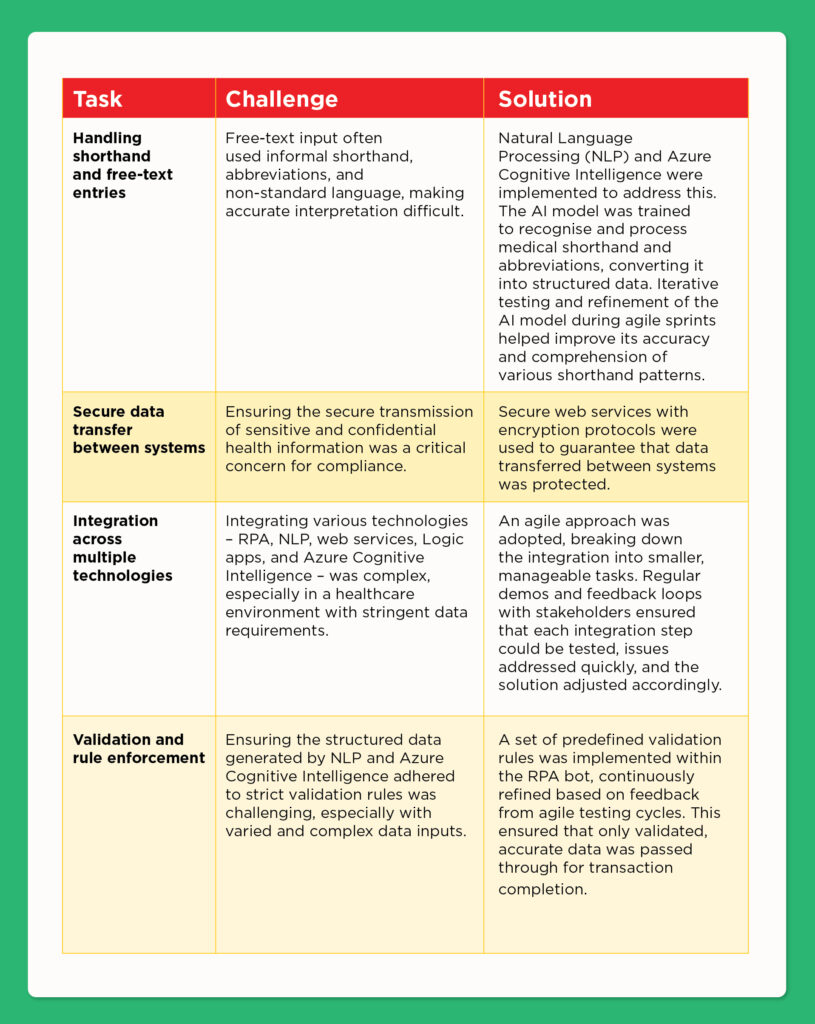
Use cases and outcomes:
We’ve identified three primary use cases for our automation efforts relating to pre-authorisation requests and/or updates for renal dialysis, specialised radiology procedures and in-hospital physio services:
1. Automate the interpretation of free text requests received for new pre-authorisations or case updates
- Service improvement need: Automate and streamline the preauthorisation process to handle free-text requests efficiently and reduce manual data entry.
- Intended outcomes: Faster and more accurate processing of the request or update, improved efficiency and customer service experience, and reduced human errors in capturing data.
2. ICD-10 and tariff code assignment
- Service improvement need: Automatically extract useful information such as ICD-10 (clinical conditions) and tariff codes from medical motivations and forms.
- Intended outcomes: Accurate and consistent assignments of clinical and billing data with minimal manual oversight, ensuring compliance with healthcare standards.
3. Data validation and transaction completion
- Service improvement need: Automate the validation process for extracted data and ensure the accuracy of the final transaction before completing the claim.
- Intended outcomes: Reliable transaction completion with accurate data, improving consistency and reducing errors in the system.
The data ingestion rate is currently providing over 90% accuracy. The automation rate for the entire solution stands at 85% straight-through processing of around 20,000 interactions per month with no manual intervention.
Reaping the benefits
- Enhanced care coordination: Automation allows skilled resources to spend more time supporting the customer journey, which enhances care coordination efforts.
- Reduced servicing times and errors: By automating internal processes and removing mundane tasks, servicing times are reduced, and the risk of errors is minimised, resulting in more consistent service experiences.
- Operational efficiency: With so many processes automated, operational efficiency has significantly increased enabling re-investment in further digital strategies.
- Improved data quality: Transforming unstructured data into structured data improves the data quality, which enables higher levels of automation.
- Efficient handling of unstructured data: Solutions focused on extracting and structuring data from emails and web portals have improved the handling of unstructured data, making it usable within business processes.
- Faster and more accurate claim processing: Automating the preauthorisation process and other routine tasks has led to faster and more accurate claim processing, improved efficiency, and reduced human errors in claims management.
- Accurate and consistent code assignments: Automation ensures accurate and consistent ICD-10 clinical condition code or tariff assignments with minimal manual oversight, ensuring compliance with healthcare standards.
- Reliable transaction completion: Automating the validation process for extracted data ensures the accuracy of the final transaction, improving consistency and reducing errors in the system.
A transformative journey
Medscheme’s journey towards automation has been transformative, significantly enhancing scheme member engagement and operational efficiency. Our commitment to innovation and customer-centric solutions has positioned us as a leader in the healthcare industry, setting a benchmark for others to follow. As automation technology continues to evolve, Medscheme remains dedicated to leveraging these advancements to further enhance our medical scheme member journey though consistent operational excellence.
Why data matters
Data is essential for automated processes because it acts as the fuel that powers automation.
- Data provides context and insights for both human and digital agents to perform their respective tasks.
- It enables the business to track performance, driving a culture of accountability, continuous improvement and innovation.
- Monitors performance – data helps track and improve process outcomes
- Supports elearning – AI and machine learning use data to get smarter.
- Provides context – data gives structure and meaning to automated tasks.
