



Coffee with Satish
Business leaders who have a deep understanding of financial matters play a crucial role in strategic decision-making, creating value and agility for our company. Their decisions directly affect our company’s trajectory on our journey to becoming the leading healthcare provider in South Africa.
We get to know Satish Antony, Executive Manager: Actuarial Consulting and Strategy, who tells us more about who he is, his career journey and the importance of seeing beyond the numbers.
Q: Tell us more about your career journey so far – some of the highlights?
A: I started off in healthcare at Old Mutual, back when Old Mutual’s Healthcare Administration and Oxygen medical aid scheme were still around. I was the pricing actuary for Medipost, and it was a familiar and welcome sight when I joined AfroCentric.
I have been with the Sanlam Group for 15 years, in various actuarial, finance and strategic roles, and across business units, including Santam, Shriram, Sanlam Emerging Markets (now Sanlam-Allianz) and at a Group level. A significant portion of my career at Sanlam has been in the emerging markets space (India and the rest of Africa), and this allowed me the opportunity to experience and appreciate different cultures, perspectives and approaches to problem-solving. It was a wonderful personal growth journey for me that I look back on fondly, and which has allowed me to appreciate the strength that is found in diversity.
Q: What are your favourite and worst parts of the job?
A: Healthcare is a complex environment, arguably more so than financial services, and more relevant on a day-to-day basis. I appreciate the tangible benefits that AfroCentric provides daily to the around four million lives in our care. When our clients engage us, in many instances these are in traumatic and emotional circumstances. The relationship that we have with our clients and members empowers them to overcome difficult experiences and I cherish this responsibility.
Healthcare is highly dependent on innovation to remain relevant, from deploying new technologies in healthcare to developing strategies that manage risks and costs efficiently. With my focus on actuarial and data aspects at AfroCentric, I am in a privileged position of using sophisticated data analytics to drive strategic decisions, optimising operations and customer satisfaction.
Given the competitive nature of South Africa’s private healthcare sector, my responsibility of managing large-scale data and the financial implications of strategic decisions can also be highly stressful, with little room for error.
Balancing the needs and expectations of various stakeholders, including patients, healthcare providers, and shareholders, can be challenging and sometimes lead to conflicting priorities.
However, I am blessed with a strong team of professionals whom I enjoy mentoring and leading in influencing the broader strategic direction of the company and in contributing significantly to its success.
Q: Actuarial science is one of the most demanding disciplines. What is your advice to anyone wanting to pursue that line?
A: My first piece of advice would be to develop a high pain threshold and a good sense of humour prior to embarking on an actuarial career. The actuarial exam process is rigorous and can take several years to complete. The high pain threshold is necessary to deal with the long study hours, non-existent social life and (sometimes multiple) exam failures. A good sense of humour helps to maintain one’s sanity.
Prepare mentally for the commitment and persistence required. Find a balance between work, studies, and personal life. Resilience is key as you might face setbacks in exams or work tasks. It’s important to learn from these experiences and keep moving forward.
A robust understanding of mathematics, statistics, and probability as core elements of actuarial science is vitally important. These numerical foundations must be established at a secondary education level before deciding to embark on an actuarial career.
The next step would be to enrol and earn a degree in actuarial science, mathematics, statistics, or a related field at a distinguished university or college. After your degree, passing the professional exams provided by a recognised actuarial society (such as the Actuarial Society of South Africa or the UK’s Institute and Faculty of Actuaries) is crucial for certification and practice.
Communication and business skills are important. Being able to explain complex mathematical concepts to non-specialists is crucial.
Gain practical experience through internships or entry-level positions in insurance companies, consulting firms, or any financial institutions that employ actuaries. This real-world experience is invaluable. Given the robust numerical and business foundation that an actuarial degree provides, many individuals use the qualification as a stepping-stone into other related fields rather than become career actuaries. The earlier that one can gain practical actuarial experience, the quicker the decision that can be made regarding whether the actuarial path is indeed the one that you want to follow.
Q: What’s your top productivity tip to get the most out of your day?
A: I follow the “Eisenhower box” technique. Divide tasks into four categories: urgent, not urgent and important, not important, and combine them as follows:
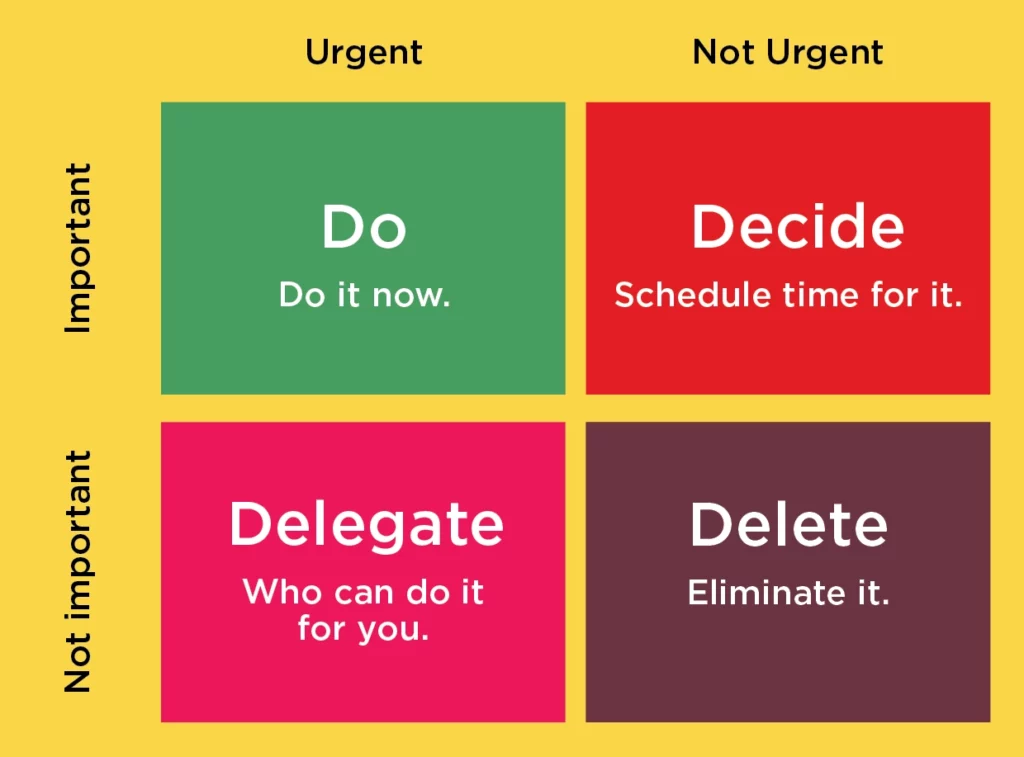
This approach allows me to focus my energy on what truly matters (urgent and important), ensuring that I address the most impactful tasks first. It also helps to prevent the common pitfall of being busy rather than being effective, and allows me to make the most of my day by aligning my efforts with my most significant goals.
Q: How do you relax and recharge?
A: I consider myself an ambivert. I enjoy social outings and love spending time with family and friends, but I also relish time alone to recharge. Going for a long run or tackling a mountain trail on my bike, reading a good book (historical fiction, non-fiction, history and biographies are my typical go-tos) are my ideal “me time” activities. I’m an avid cricket and F1 supporter. South Africa and Ferrari have my die-hard support!
Q: Who inspires you and why?
A: I tend to look for inspiration in everyone and every situation that I encounter. Each person that I meet and every experience that I have offers unique insights and lessons, enriching my life and broadening my perspective. This universal openness to inspiration has helped to drive my personal growth and fuel my inspiration, and reminds me that every moment is an opportunity to learn something valuable.
Q: What’s on your playlist right now?
A: Whitney Houston’s 1998 album, “My Love is Your Love”. Whitney blended R&B with reggae and hip-hop influences to craft a sound that was both fresh (for its time and remains so!) and deeply personal. The album not only highlights Whitney’s versatility and depth as an artist, but also resonates with a sense of resilience and sincerity. Each track offers an emotional journey, making it an uplifting listening experience.
Q: What book are you reading?
A: I am currently reading A Little History of Economics by Niall Kishtainy. The book has helped to not only broaden my knowledge of economics but also deepen my appreciation of the impact of economic principles on societal progress and individual welfare.
Q: In honour of Youth Month (June), tell us what you wanted to be when you grew up?
A: I wanted to be a palaeontologist. I was 10 years old when the original Jurassic Park movie came out, and it’s the first movie that I watched “on the big screen”, here in Cape Town. I was hooked! I was inspired to journey deep into the forgotten parts of the world, digging up fossils.
Q: What is one thing nobody knows about you?
A: My belief is that any fulfilling relationship is based on the tenets of trust and transparency. I am celebrating my 10th wedding anniversary in 2025. If I am up to something, there is at least one person who knows about it.
Q: What makes you smile?
A: Mother Teresa once said about smiling, “Let us always meet each other with a smile, for the smile is the beginning of love.” I have adopted this approach, not just in my interactions with people, but in everything that I do.
